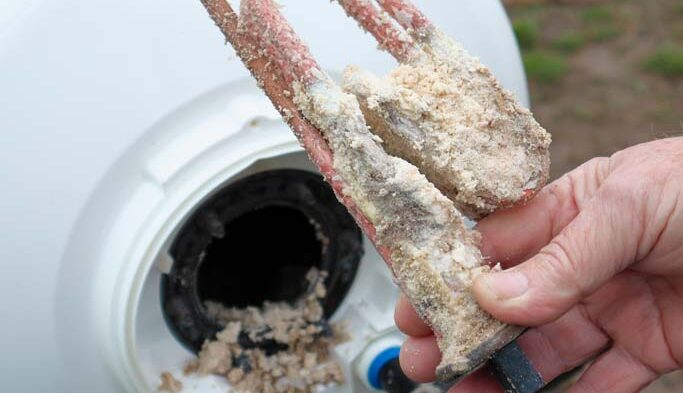
Hard water is common throughout Florida and Georgia, particularly in areas where groundwater contains high concentrations of calcium and magnesium. While those minerals may not seem like a major problem, they can create scale inside your water heater, plumbing, fixtures, and appliances over time.
The short answer: Hard-water scale can make a water heater work harder, contribute to maintenance and premature equipment replacement, and add to everyday household expenses for cleaning products and bottled water. UDI’s own homeowner cost comparison identifies water heaters, washing machines, dishwashers, faucets, fixtures, and plumbing among the equipment that can be affected by hard water.
For homeowners dealing with these issues, treating water before it travels throughout the house is the more comprehensive approach. UDI’s Hydro-5 STS provides whole-home water treatment, while the ULTRA-6 Drinking Water System provides additional reverse osmosis purification specifically for drinking and cooking water.
What Does Hard Water Do to Your Water Heater?
When hard water is heated, dissolved calcium and magnesium can form mineral deposits known as scale.
In a traditional tank water heater, these minerals can collect as sediment on the bottom of the tank and around heating surfaces. In tankless systems, scale can accumulate inside the heat exchanger and internal waterways.
Over time, that buildup can:
Reduce efficient heat transfer
Make the water heater work harder
Increase maintenance and descaling needs
Contribute to reduced hot-water performance
Add wear that may shorten the system’s useful life
And your water heater isn’t the only concern. Washing machines, dishwashers, fixtures, faucets, pipes, and plumbing are other areas where hard water damage can create repair or replacement expenses.
What Could Hard Water Be Costing You?
The cost of hard water isn’t always one big repair bill. Often, it shows up through multiple ongoing household expenses.
Scale can contribute to appliance maintenance and replacement, while homeowners may also spend more on detergents, cleansers, lotions, and personal-care products to compensate for the effects of untreated water. These categories as recurring household costs associated with living with hard water.
Then there is drinking water.
The estimated average cost of bottled water for an average homeowner is:
$34.28 per week
$137.11 per month
$1,645.34 per year
$16,453.40 over 10 years
Over the lifetime of owning a home, the combination of bottled water costs, household products, energy use, maintenance, and appliance replacement can represent a meaningful expense. Plus, it doesn’t matter how hard you work, or how much money you spend, you still have the inconvenience of hard water unless you address the root of the problem.
Use WQRF’s calculator to explore the potential benefits and savings associated with reducing the hardness levels of your water supply.
Why Whole-Home Treatment Makes a Difference
A whole-home water treatment system takes a more proactive approach by treating water as it enters the home. That means the benefits can extend to your water heater, plumbing, laundry, bathrooms, kitchen, and other water-using appliances.
The Hydro-5 STS is designed as a whole-home solution for homeowners who want to address water quality throughout the house rather than treating individual symptoms one appliance or fixture at a time. Take the broader philosophy of investing in a top-quality long-term solution instead of expensive short-term spending. For just a few dollars more per month, on average, you can take care of your water for lifetime! Not only are you receiving much higher quality water being treated five separate ways, but you are also covered with a complete Lifetime guarantee! Every component is the highest quality available. At UDI, we truly believe an investment in the Hydro-5 STS is the best investment a family can make. Our thousands of customers tell us that every day!
What About Drinking Water?
Whole-home treatment and drinking-water purification serve different purposes.
For homeowners who want an additional level of purification at the tap, the ULTRA-6complements the Hydro-5 STS by further conditioning and purifying water through reverse osmosis specifically for drinking and cooking purposes.
Think of it as a two-part strategy:
Hydro-5 STS: treats the water used throughout your home.
ULTRA-6 RO: provides premium purified water for drinking and cooking.
Is Hard Water Affecting Your Home?
White scale around faucets, spotted dishes, buildup on shower glass, frequent water-heater maintenance, and declining appliance performance can all be reasons to take a closer look at your water quality.
The best place to start is with a free in-home water test. Knowing what’s actually in your water makes it possible to choose treatment based on your specific needs—and address the problem before years of mineral buildup turn into unnecessary maintenance, replacement, and household spending.